Overview → The Land

The Land & Layout

660 × 660 ft square in a rural outer county — the grid every bucket sits on.

01 The numbers

10 ac
Total land
6.5 ac
Productive
5–6
Grazing paddocks (fixed)
~230
Trees — ~80 orchard/silvopasture + ~150 windbreak
0.5 ac
Stocked pond
~$430k
Onto the land

Working assumptions

Land ~$150k (outer county — Cooke / Fannin / Hopkins / Hunt) · basic 4-bed/2-bath square ~2,000 sf, ~$200k · 20×40 shop deferred · owner does most site work · one machine to start (compact tractor; rent a skid for the earthmoving weeks).

Design calls

Cattle + chickens only — one milk cow, a beef calf a year, a laying flock and meat birds. Grid on flat ground, contour on slope — clean square cells, but the swales and pond follow the actual low.

Where Within ~an hour of DFW — north & south

Best-fit counties for this plan — a ~10-acre square with road frontage, a pond, pasture, a well, and a low price. Heavy blackland clay grows great pasture and holds a pond but is poor for sandy-loving crops (peanuts, blueberries) and needs an engineered slab; pockets of sandy loam flip that. Either direction is still Zone 8a/8b, so lemons/limes/oranges always need the greenhouse. School ratings swing a lot by county and district, so each table flags the standout ISD — verify current A–F grades for the exact attendance zone (the zone, not the county, sets your school) at txschools.gov, GreatSchools, or Niche.

North & northeast of DFW — the plan's original target: more sandy-loam near the Red River (better for the diversification crops) and strong small-town schools.

County (towns)Drive*SoilSchools (standout ISD)Fit for this plan
Grayson — Van Alstyne, Gunter, Sherman, Pottsboro~45–70 min NSandy loam (Red River) + blacklandStrong, fast-growing — Van Alstyne & Gunter ISD; Pottsboro, HoweSweet spot: sandy-loam spots for orchard/berries, Lake Texoma/Ray Roberts, still rural but prices rising fast
Cooke — Gainesville, Muenster, Lindsay, Era~55–75 min N (I-35)Sandy loam + Cross TimbersSmall standouts — Muenster, Lindsay, Era ISD; Gainesville is the larger oneI-35 access + Ray Roberts lake; sandy pockets suit fruit & berries; cheaper land than Grayson
Fannin — Bonham, Honey Grove, Leonard~60–85 min NESandy loam (Red River) + blacklandRural — Bonham, Honey Grove, Sam Rayburn ISDCheapest of the north; many 10-ac pasture tracts with road frontage; new Bois d'Arc Lake nearby
Hunt — Greenville, Quinlan, Commerce~45–65 min NE (I-30)Fertile loamy / clayey blacklandGreenville (largest); Quinlan, Boles, Commerce ISDDeep land inventory + productive pasture/hay; affordable; Lake Tawakoni; clay is weak for sandy crops

South of DFW — the citrus-microclimate scoping (lake-buffered freezes, more sandy-loam pockets the further southeast you go).

County (towns)Drive*SoilSchools (standout ISD)Fit for this plan
Ellis — Waxahachie, Ennis, Italy~30–50 min SHeavy blackland clayStrongest of the four — Midlothian ISD (B, ~85% campuses A/B); Waxahachie & Red Oak ISD solidClosest + most services, but priciest; rich pasture & holds a pond; clay is poor for sandy crops
Johnson — Cleburne, Rio Vista, Alvarado~40–55 min SWBlackland E / sandier + rocky WGodley & Grandview ISD well-regarded; Rio Vista small/ruralBest proximity-to-price balance — and "Rio Vista" fits the name. Check minerals hard (Barnett Shale).
Navarro — Corsicana, Kerens~60–75 min SESandy-loam pocketsMildred ISD the rural standout; Corsicana ISD is the largest/most servicesBest for diversification (peanuts, blueberries, sweet potatoes); Richland-Chambers lake buffers freezes for citrus; affordable
Hill — Hillsboro, Whitney~55–70 min SBlackland + some sandMostly rural — Whitney & Hillsboro ISD; tiny Abbott ISD historically strongBest raw value (biggest budget lever); strong ranch culture; Lake Whitney

*Drive times are from the nearest metro edge — add ~30–45 min from the opposite side of the Metroplex. Counties further out (Hopkins to the NE; Collin's rural edge) trade more drive or more money for the same acreage.

The pick Top 3, graded

Ranked by (1) school rating, then (2) price, then (3) land viability — and since citrus lives in the greenhouse either way, "land" here means pasture, a pond site, and the sandy-loam diversification crops, not citrus.

#County1 · Schools2 · Price3 · LandWhy it ranks here
1Grayson (N) — Van Alstyne / GunterA−BA−Best weighted blend: strong, fast-growing schools without metro pricing, plus sandy loam + lakes
2Johnson (S) — Godley / GrandviewB+BBNearly the schools, closest-to-metro balance; mixed soil — check Barnett-Shale minerals
3Navarro (S) — Mildred / CorsicanaB−A−ASchools a step down, but cheapest + best land (sandy loam, lake-buffered freezes)

Grades are this plan's relative ranking, not official TEA scores — verify each attendance zone at txschools.gov. Honorable mentions: schools over budget → outer Collin (Melissa A, Prosper, Celina) or Ellis (Midlothian B) — pay the premium, 10-ac is scarce; lowest price → Fannin / Hunt (N) or Hill (S).

Homeschool changes the math — everywhere. Texas is one of the most homeschool-friendly states: homeschools count as private schools with no registration, notification, or testing, and the 2025 Homeschool Freedom Act (HB 2674) bars state agencies from regulating them — you just teach reading, spelling, grammar, math, and citizenship from a visual curriculum (THSC). If you'll homeschool, criterion #1 (school rating) mostly drops out — re-weight toward price + land, which flips the Top 3 toward Fannin, Hunt, and Navarro. The only thing that varies by location is co-op / community density: richest metro-adjacent (McKinney, Sherman, Denton, Waxahachie), thinner deep-rural — but THSC lists co-ops in all 254 counties, backed by 4-H and online academies. See the Find-the-Land checkpoint for due diligence.
02 Master layout

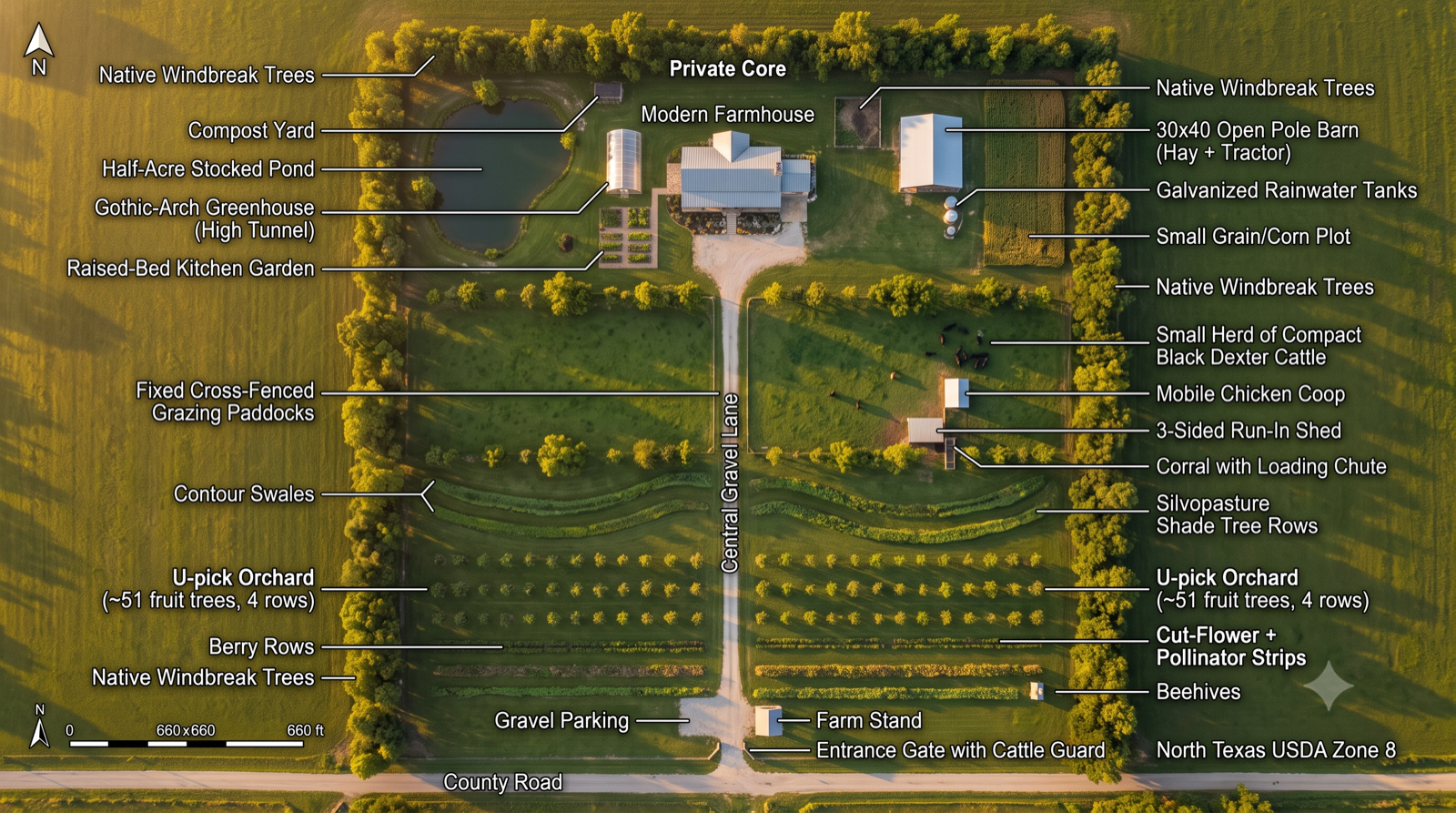
Three privacy bands, south → north: public → animals → private. A central lane doubles as the private drive from the road gate to the house. Customers stop at the parking + farm stand up front and never pass the private gate. North up, county road on the south edge.

Master layout · 660 × 660 ft · north up
Master site plan — 660 × 660 ft, north up. Three bands from the county road (south) to the back (north): a public front with parking, farm stand, U-pick orchard, and berries; a fenced cattle grazing + silvopasture middle with handling pen and hay stockpile; and a private core with the set-back house, half-acre pond, greenhouse and shop. Native windbreak on the north, east and west edges; a central lane from the road gate to the house.

The site-plan render follows the selected render set — switch versions bottom-right.

Grazing is 5–6 fixed cattle paddocks, sub-dividable with portable polywire when you want smaller cells. See Animals. The public node (stand, parking, U-pick) is reserved space — build it only if you pursue income.

Design Why it's laid out this way

Two goals drove every placement: build soil and close loops (regenerative), and keep the daily work short for two people (ease of use). The three privacy bands carry both — and the store + U-pick stay up front on purpose.

Regenerative by design

  • Water captured high → stored low. Roof → tanks; contour swales above the orchard slow and sink runoff into the tree roots; overflow ends in the NE pond — irrigation reserve, fire water, recreation, habitat.
  • Grazing is the engine. 5–6 fixed paddocks on ~30-day rest; the mobile coop follows 3 days behind to spread manure and break the parasite cycle.
  • Silvopasture + windbreak. Shade trees in the paddocks (heat relief, mast, deep-root carbon); a native double-row windbreak on the N/E/W edges.
  • Closed loops. Compost sits between the animals and the garden — manure in, fertility out, short haul; scraps + dropped fruit feed the flock; field corn trims the feed bill.
  • Edges for life. Pollinator strips + hives at the orchard edge; pond riparian buffer and an uncut wild margin.

Easy to run for two

  • One central lane = one chore route. Every paddock, the orchard, and the barnyard gate onto it — the tractor reaches all of them without backing through another.
  • Effort radiates from the house. The daily zones — kitchen garden, greenhouse, coop, compost, the cow's loafing shed + handling — cluster in the private core, in view from the house.
  • Water everywhere. Frost-free hydrants at every paddock, the garden, and the orchard — no hauling.
  • Dry storage, central. The hay + equipment pole barn sits on the lane by the core; winter feeding is a short trip, and the run-in shed is in the sacrifice paddock.
  • The public self-contains up front. Parking, farm stand, and U-pick orchard sit at the road — customers never cross into the animal or private zones (biosecurity, privacy, safety).
Permaculture zones, laid over the bands: Zone 1–2 (daily — garden, greenhouse, coop, compost) hugs the house in the private north core; Zone 3 (regular — pasture, orchard) fills the middle and the public front; Zone 4–5 (silvopasture, windbreak, pond riparian, wild margin) lines the edges and the low corner. The store + U-pick up front is the one public-facing zone, kept at the road so it never touches the working farm or the home.

03 Land-use breakdown

Which bucket each acre serves. Sums to 10.0 acres.

ZoneBucketAcres
Homestead core — private (house, shop, drive) + public node (stand, parking)A1.0
Garden zone (raised + in-ground, greenhouse, compost, wash, herb)B0.5
OrchardC1.2
Berry productionC0.4
Pollinator + native habitatE0.5
Grazing paddocks (incl. silvopasture)D3.6
Pond + riparian bufferE0.9
Perimeter windbreak (native)E0.6
Farm roads / lanesA0.6
Grain / corn plot (rotated)B0.3
Future expansion / wildlifeE0.4
Total10.0
Renders